
Prepare your organization forArtificial Intelligence
The smart learning platform that trains employees in safe and effective AI use. Reduce data risk, build AI confidence and unlock productivity.
Everything your organisation needs
Safer work, more productive results, and full insight into your organisation's progress.
Learning
Guided modules with clear chapters and progress tracking. Employees learn at their own pace, with illustrations and concrete learning goals for each lesson.
Quiz
Test knowledge with multiple-choice questions and receive immediate targeted feedback. Everyone instantly knows what they understand and what still needs attention.
Insights
Complete overview of AI literacy per employee and department. Radar charts and heatmaps show at a glance where your team stands.
Everything your organisation needs
Safer work, more productive results, and full insight into your organisation's progress.
The Basics
Next modules
AI, back to basics
Back to basics
You hear the term everywhere. In the news, at work, at the dinner table: "Artificial Intelligence". Often said as if it were something magical, or something that will take over your job tomorrow. Let's peel back the layers together!
In this chapter we go back to what AI really is. No science fiction, no marketing hype. Just: what does it actually mean?
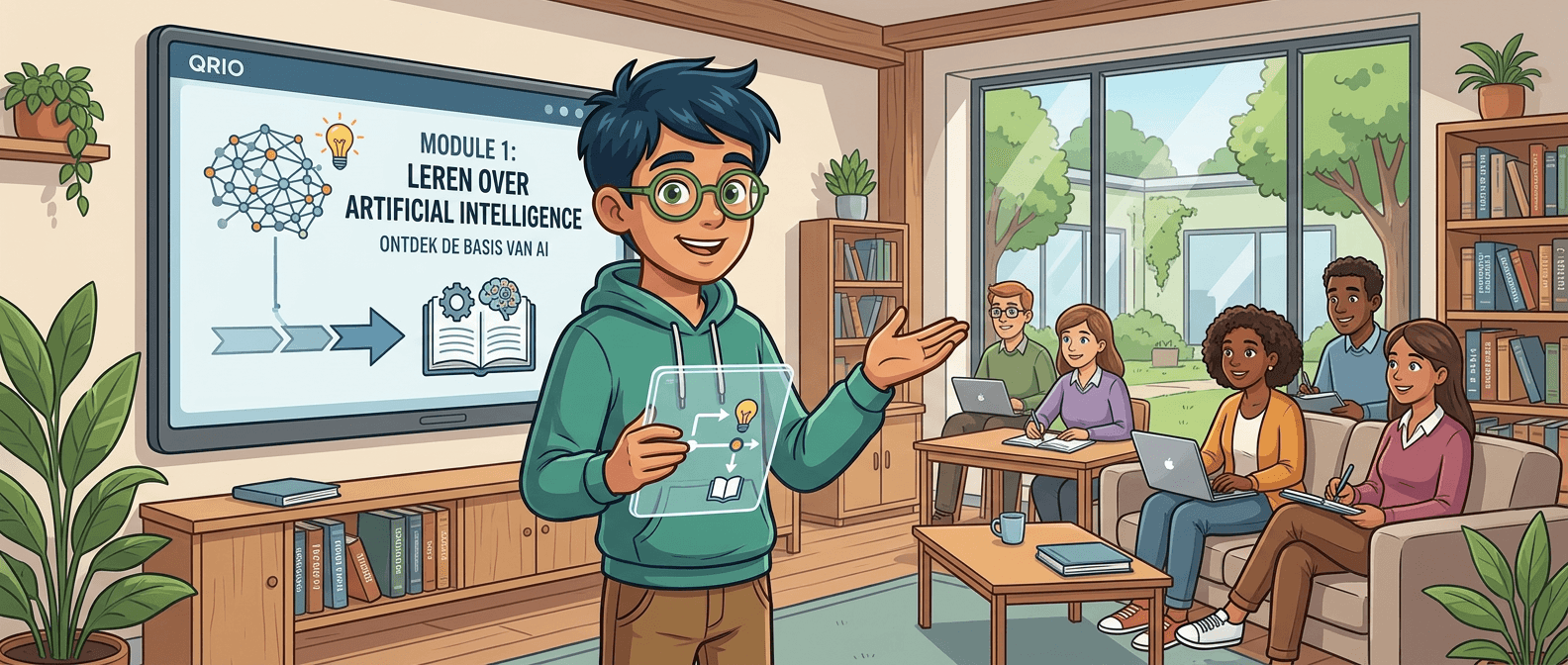
Learning objectives
After this chapter you can explain in your own words what Artificial Intelligence is. And you understand the difference between a computer that calculates and a computer that learns. And that difference is bigger than you think!
Artificial Intelligence in brief
Artificial Intelligence is an umbrella term. It refers to systems or software that mimic human intelligence to perform tasks.
AI is not one device. It is not a robot or a computer; it is software that can do two things very well.
-
First: recognise patterns. AI looks at enormous amounts of data and finds connections that we as humans often cannot see. A person may look at a thousand photos. An AI does ten million, and remembers every detail.
-
Second: make predictions. Based on those patterns, the system makes a decision, or makes a guess about what comes next.
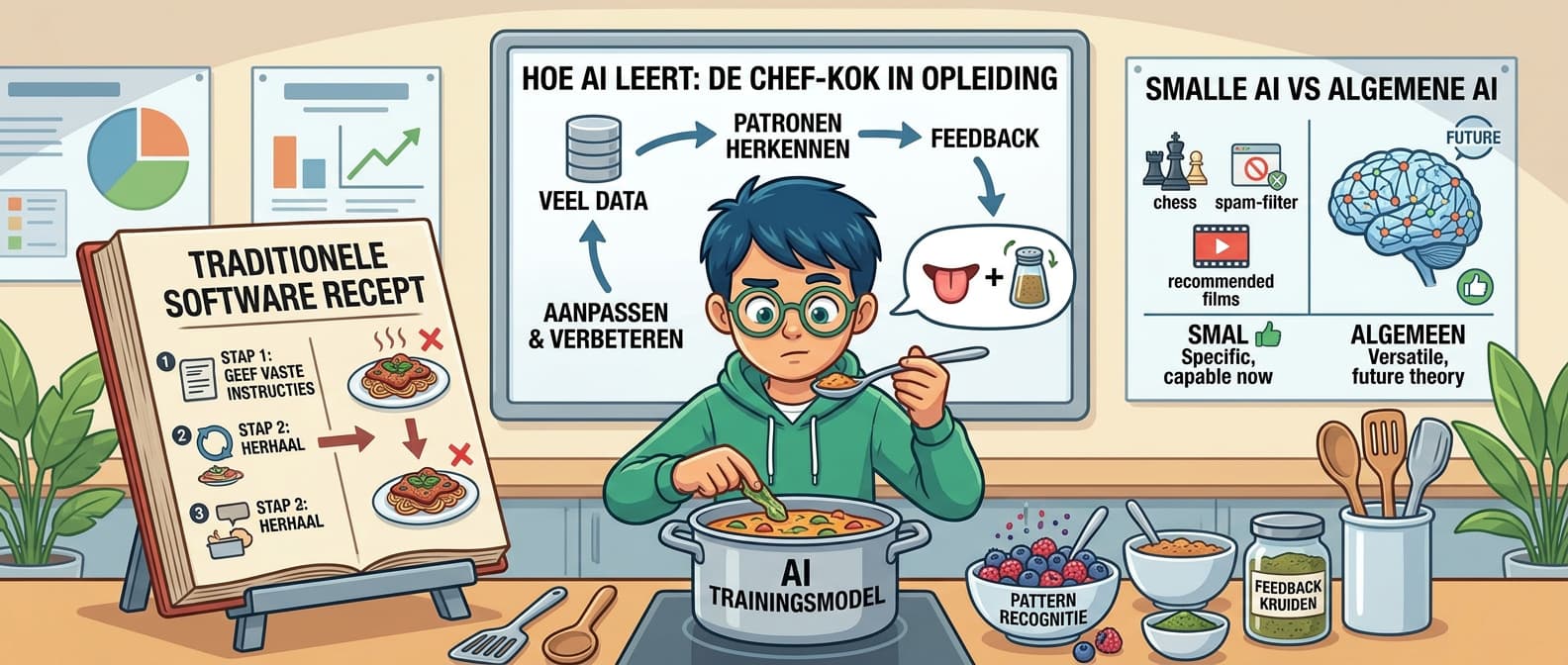
The difference from traditional software lies in the approach. Traditional software works like a cookbook. It follows fixed instructions step by step. If there's a mistake in the recipe, the dish fails every time. The computer doesn't notice.
AI works more like a trainee chef. Instead of just reading the recipe, the system tastes the result. Too salty? Less next time. Too bland? A bit more seasoning. It learns through training and feedback, not through pre-defined rules.
Narrow versus general AI
Time for an important distinction. Many people think of AI as the robots from films. Computers that are as smart as humans, with feelings and their own will. We're not there yet. Honestly, not even close.
In practice, we divide AI into two categories:
-
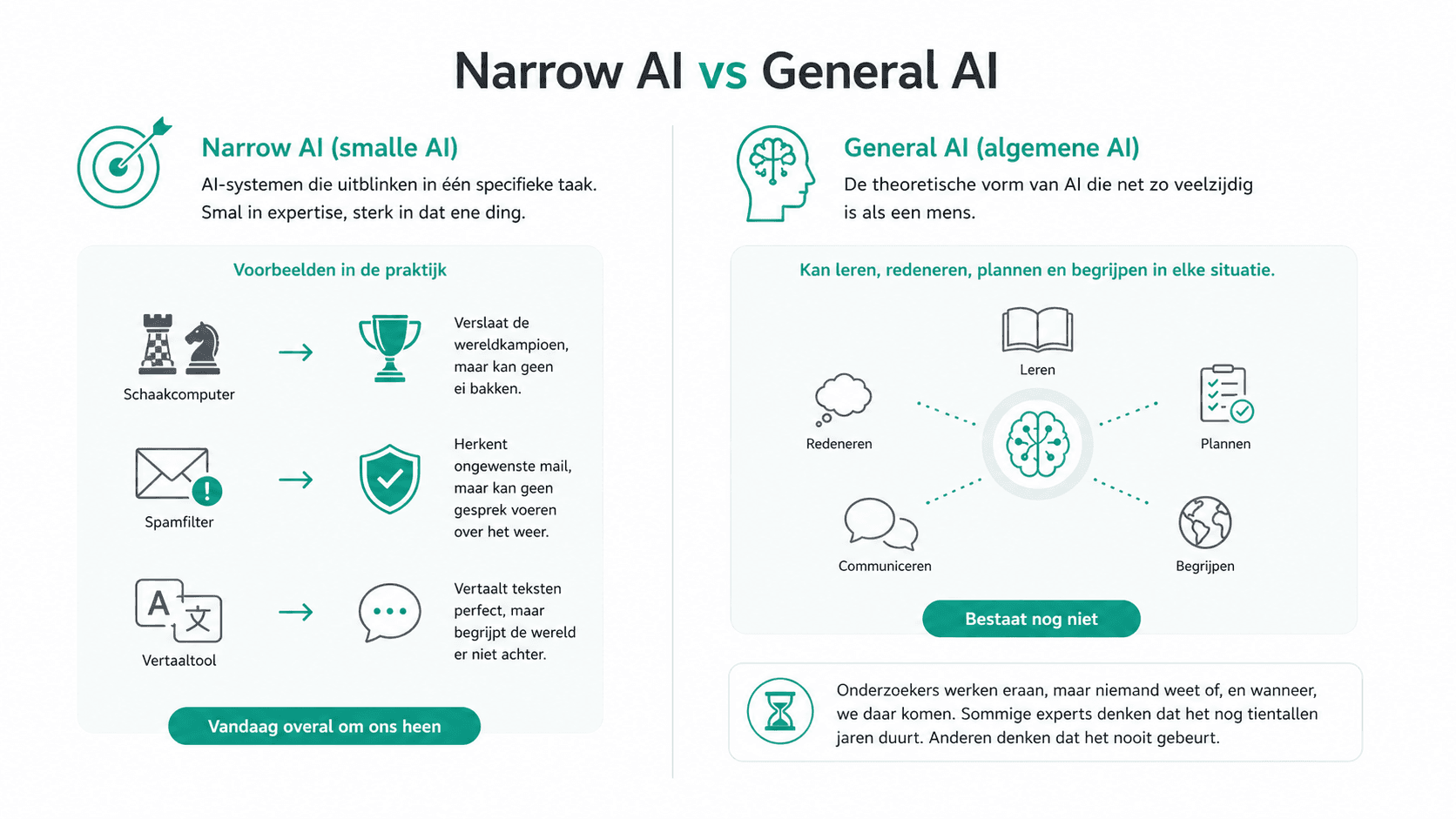
Narrow AI is what we see everywhere around us today. These systems excel at one specific task. A chess computer beats the world champion, but can't fry an egg. A spam filter recognises unwanted mail, but can't hold a conversation about the weather. Narrow in expertise, strong in one thing.
-
General AI is the theoretical form. An AI as versatile as a human. That can learn, reason, plan and understand in any situation. This doesn't exist yet.
Everything you use now, from ChatGPT to Google Translate, falls under narrow AI. Even if it sometimes feels enormously broad.
A real-world example
Think of something you probably use daily: Netflix or Spotify.
You open Netflix and immediately see a row of recommendations. "Because you watched The Crown." How does Netflix know you probably want to watch a historical series?
This is narrow AI in action, in three steps.
-
First the data. The system remembers everything. What you've watched, how long you watched, at what point you dropped off, where you gave a thumbs up. Together billions of data points.
-
Then the pattern. The system compares your behaviour with that of millions of other viewers. "People who liked The Crown often liked Downton Abbey too." No person draws that conclusion manually. An algorithm does, in milliseconds.
-
Finally the prediction. The AI pushes Downton Abbey to the front of your screen. And if you click on it, the system learns something new.
The system doesn't understand what love is, or drama, or history. It sees mathematical patterns in viewing behaviour, nothing more. Ask the same AI to do your tax return and you'll get nowhere.
In summary
- AI is software that mimics human intelligence by recognising patterns and making predictions.
- The fuel is algorithms and a lot of data.
- Today we use narrow AI: systems that excel at one task.
- General AI, with human versatility, doesn't exist yet and is still a thing of the future.

Learn what AI means for you?
Follow accessible courses, play challenging quizzes and unlock new modules. Beat your colleagues on the leaderboard and turn boring compliance training into a fun, competitive challenge.
- Accessible AI courses for everyone
- Challenging quizzes that test your knowledge
- Climb the leaderboard
Become a true AI pro
Get inspired by real-world examples and dive into our searchable knowledge base. Step by step, you build your AI expertise.
- Discover how AI transforms your work
- Searchable knowledge base with every key concept
- Practical examples from your sector
Provide proof that you comply
Responsible AI use means being able to demonstrate that your staff is AI-literate. Qrio provides that proof: a measurable learning track with assessment, certification and a complete audit trail.
Real-time progress & certification
See at a glance who is on track. Employees automatically receive a certificate after successful completion.
Audit-ready reports & exports
Download exports with one click for internal checks or regulators, including full insight into assessment results.
Multi-tenant insight per department
Filter by team, location or role. That way you see exactly where additional training is needed.
Add your own content
AI literacy only sticks when it reflects how your team actually works. Easily upload your own modules, policy documents and tools, so employees learn what is truly relevant to their roles.
- Full Learning Management System with custom content
- Test employees on your own material and guidelines
- Custom content counts toward the AI literacy certificate
Qrio adapts to your sector
Whether you work in healthcare, education, or legal: Qrio provides targeted AI training aligned with the specific challenges and compliance requirements of your industry.
Business
Stay competitive with an AI-skilled team
Employees use AI tools regardless of policy. Qrio ensures they do it safely and productively. From marketing to finance: your teams learn to use AI as a powerful assistant without putting business data at risk.
Modules in this programme
Qrio Modules for Business
- 01Marketing & SalesAI tools for campaigns, lead generation, and client communication.
- 02HR & RecruitmentSmarter recruiting, onboarding, and HR with AI.
- 03Finance & LegalFinancial reports and legal documents with AI.
- 04Operations & ProductivityAutomate processes and boost daily productivity.
- 05Strategy & InnovationAI as a strategic tool for innovation and competitive advantage.
Ready to make your team AI-literate?
Frequently asked questions
Answers to the most common questions. Still curious? Our team is a message away.
AI literacy is the combination of skills, knowledge and insight employees need to use AI systems responsibly and effectively, with an understanding of the associated risks and limitations. Since 2 February 2025, Article 4 of the EU AI Act requires organisations that develop or deploy AI systems to demonstrably safeguard the AI literacy of their staff.

Welcome back, Sarah
Soon also on your phone
Learn on the go, at your own pace. The Qrio app brings micro-learning, quizzes and your progress straight to your smartphone.